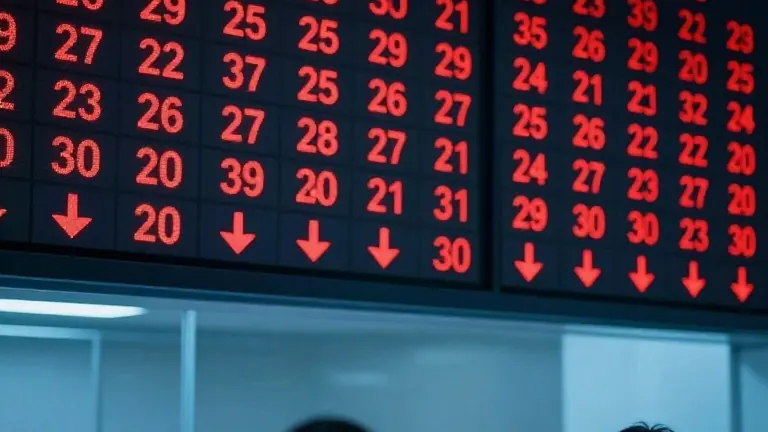
Eurozone Grows 0.4% Despite Iran War
Household spending held steady in the third quarter, defying expectations of a sharper economic slowdown caused by rising oil costs.
By Beatriz Soto ·

The European economy expanded by 0.4 percent in the third quarter, according to data released on Friday.
Eurostat, the statistics agency for the European Union, reported that the 21 nations using the euro currency saw this increase compared to the previous quarter. The result exceeded the 0.2 percent growth forecasted by market analysts. Over the same period a year earlier, the region’s economy grew by 1.3 percent.
Jack Allen-Reynolds, deputy chief eurozone economist at Capital Economics, stated that households and businesses did not cut back on spending because of the conflict with Iran. Paolo Grignani, a senior economist at Oxford Economics, described the economy as resilient despite geopolitical instability and rising inflation.
Energy costs rose due to the war, creating pressure on the wider market. Grignani noted worrying signs that high oil prices are influencing wages and prices in other sectors. These secondary effects often lead central banks to maintain or increase interest rates. Inflation currently sits at 3.8 percent, which is higher than the 2 percent target set by the European Central Bank. The central bank kept rates unchanged during its policy meeting on Thursday. It may raise rates at its next meeting in December to control prices, which would increase borrowing costs for businesses and families.
Growth was uneven across the region. Germany, the largest economy in the group, grew by 0.2 percent despite high energy bills and low river levels that hindered trade. France shrank by 0.1 percent as political disagreements over its budget deficit affected business confidence. Spain, the Netherlands, and Estonia performed better, each seeing growth of 0.6 percent. The overall figure was influenced by a 5.5 percent surge in Ireland, where multinational tech and pharmaceutical companies distort the data. Excluding Ireland, the growth rate was 0.2 percent.
The next major policy decision for the European Central Bank is scheduled for December.
More Business · Bad Business · Report a business · Got a Story?