November 2026 Sky Guide: Meteor Shower Peaks and Planetary Alignments
The Leonid meteor shower reaches its peak on November 16 and 17, while Jupiter, Mars, and the moon form a line in the pre-dawn sky on November 2.
By Isaac Medina ·
The Leonid meteor shower reaches its peak on the nights of November 16 and 17, 2026. This timing is favorable for observers because the moon will not interfere with visibility. The shower is designated as the star of the month for November.
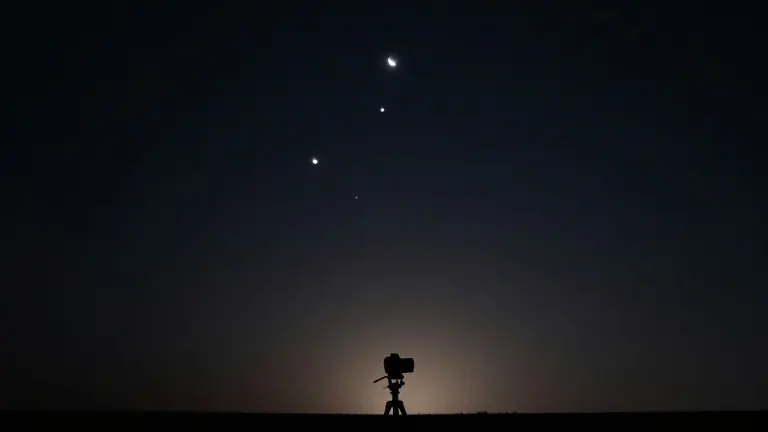
On the morning of November 2, a specific alignment will be visible in the eastern sky before dawn. The waning crescent moon will appear in a line with bright Jupiter, reddish Mars, and the star Regulus. This formation will stretch across 13 degrees of the sky. The moon will show earthshine, which makes it a suitable target for smartphone photography using zoom or digital camera settings.
The variable star Algol will reach its minimum brightness on multiple dates this month. These events include November 4 at 1:45 a.m. EST, November 6 at 10:45 p.m. EST, November 9 at 7:23 p.m. EST, November 27 at 12:17 a.m. EST, and November 29 at 9:06 p.m. EST. During these times, the star will dim for approximately two hours before becoming brighter again.
Venus and the star Spica will be close to each other in the eastern horizon around 5:30 a.m. EST on November 7 and November 10. A clear view of the eastern horizon is required for best viewing. The thin waning crescent moon will also be visible with Venus and Spica on November 7.
Mars and Jupiter will stay in close company in the eastern sky after midnight on November 16. The gibbous moon will join this group of objects high in the east before dawn on November 30 around 5 a.m. EST. Venus and Spica will also remain close near the eastern horizon on that date.
The full Beaver Supermoon will occur at 9:53 a.m. EST on November 24. This moon will rise at sunset on November 23 and 24 in the east. These times are optimal for taking pictures of the full moon.
Daylight saving time will end at 2 a.m. on November 1 for most of the United States and Canada. The moon will be in its last quarter phase on November 1, new on November 9, and first quarter on November 17.
Planet visibility varies throughout the month. Mercury will be very low in the east in the morning twilight after the first week. Venus will be low in the east before dawn. Mars and Jupiter will be in the east late evening. Saturn will be in the east after sunset. Uranus and Neptune will be in the western sky after dark, with Uranus visible in binoculars and Neptune requiring a telescope. Pluto requires images taken through a telescope over several days to locate.
Astronomy programs are scheduled in the D.C. region. Shenandoah National Park hosts "Let's Talk About Space" presentations and ranger night sky programs. Virginia State Parks also offers astronomy programs. The NOVAC Meeting at George Mason University, the National Capital Astronomers, and the Analemma Society at Turner Farm in Great Falls, Virginia, will hold events. The Smithsonian Air and Space Museum in D.C. and Chantilly, Virginia, will feature astronomy exhibits and the new attraction Smithsonian Starstruck: An Immersive Experience.
Observers can use smartphone astrophotography guides and custom star chart tools to assist with viewing. The Night Sky Network and the Astronomical League list events outside the D.C. area.