Trump's $5,000 'Dividend' Fades as Midterm Results Shift
The promise made in Dallas hinged on a Republican hold of Congress, a scenario now unlikely given Tuesday's sweeping Democratic victories.
By Isaac Medina ·

President Donald Trump pledged a $5,000 payment to every American adult if Republicans retained control of both chambers of Congress, a promise that has become increasingly tenuous following Tuesday's election results. The pledge was made at the Republican Midterm Convention in Dallas, where Trump told the crowd, 'If the Republicans win, you win with us and you get $5,000,' labeling the initiative the 'Trump dividend.'
The proposal was explicitly conditioned on the GOP keeping the House and Senate. Trump stated that the payment would be issued to every adult citizen in the United States of America, citing the country's tremendous economic success as the rationale. He compared the check to corporate dividends and noted that his administration had already provided $1,776 checks to military members.
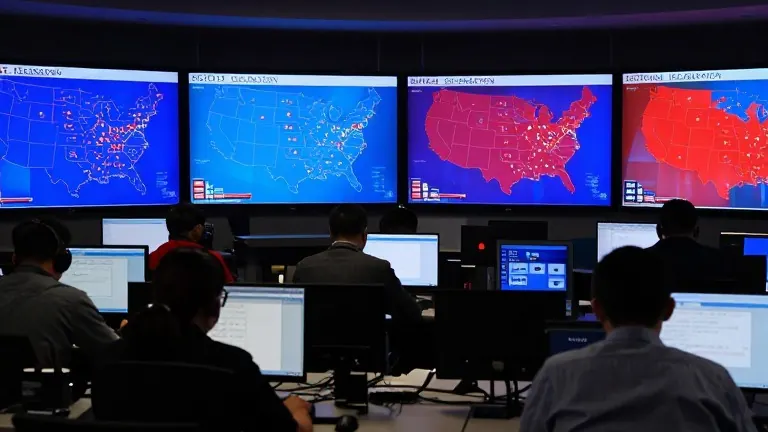
However, the political landscape required to trigger this payment has largely dissolved. According to the Associated Press, Democrats are poised to take control of both the U.S. House and the U.S. Senate, marking a decisive rebuke to the President's party. This outcome means the specific condition for the dividend, a dual Republican victory, has not been met.
Speaker Mike Johnson, who campaigned heavily for the GOP hold, indicated that congressional approval would be necessary for the payment to proceed. Speaking on Sunday before the vote, Johnson said he would assume the President needed Congress to act, calling it a creative idea. He pledged that Congress would work through the proposal and find consensus, despite the slim Republican margins they faced going into the election.
Trump initially downplayed the need for legislative action, telling CBS News Texas that he did not think Congress would need to authorize the payments. He later asserted in a Fox News interview that inflation was solved and that the results would be better than expected, even as consumer prices had risen 3.6 percent in September according to the Commerce Department.
Bipartisan criticism emerged early in the campaign cycle. Texas Congressman Chip Roy, a Republican, wrote on social media that dependency is evil and soul-sucking in all its forms. Democratic figures also questioned the feasibility of the plan, noting that the President lacks the unilateral power to distribute such funds without legislative backing.
Election law expert Rick Hasen of UCLA noted that while the promise is likely legal under the First Amendment as a campaign pledge, the execution is complicated. Hasen stated that the President does not have the power to do this on his own and that Congress must act. He compared the pledge to other campaign promises, such as tax cuts, which are constitutionally protected but require legislative implementation.
PolitiFact reported that the $5,000 payment faces enormous obstacles, with the administration announcing no formal plan for distribution. The payment could cost the federal treasury more than $1 trillion, a figure that would strain the country's nearly $1.8 trillion annual budget deficit. Fiscal experts cast doubt on the plan during a time of existing economic challenges and persistent inflation.
In the Mid-Atlantic region, polls closed between 6 a.m. And 8 p.m. Depending on the state, with Virginia closing earliest at 7 p.m. And Pennsylvania, Delaware, and Maryland closing at 8 p.m. Ballotpedia data confirms that incumbent Democratic senators Chris Coons in Delaware and Mark Warner in Virginia were easily reelected. In governor races, incumbents Josh Shapiro in Pennsylvania and Wes Moore in Maryland were part of a wave that delivered a majority of governorships to Democrats for the first time in two decades.
The loss of the Senate majority is particularly significant for the dividend's prospects. Political analysts noted that the legislation required to fund the payment would likely need a 60-vote supermajority in the Senate to overcome procedural hurdles. With Democrats now projected to hold the majority, the path to passing the specific bill Sen. Bernie Moreno promised to introduce immediately after the election has become significantly steeper.
The White House defended the plan in a statement, saying President Trump has consistently proven his doubters wrong and drawing a contrast with the Democrats' record of historic inflation. However, with the condition of a Republican Congress no longer in effect, the 'Trump dividend' remains a promise without a clear mechanism for delivery, leaving millions of voters who supported the GOP hold without their anticipated check.