2,000 Hebron Residents Evicted as Army Seizes Homes After Checkpoint Attack
Military forces sealed the city and demolished businesses following the killing of two soldiers, a move critics say aids the prime minister's election campaign.
By Anthony Shevchenko ·
Hebron, the largest city in the West Bank, had previously received little attention from Israeli voters, but it now stands at the center of the political campaign ahead of Tuesday’s election.
The change in focus followed a gun attack on Friday at an Israeli military checkpoint that resulted in the deaths of two soldiers.
Prime Minister Benjamin Netanyahu and Finance Minister Bezalel Smotrich visited the scene on television, promising swift retribution and warning of military operations on a scale unseen in nearly 60 years of occupation.
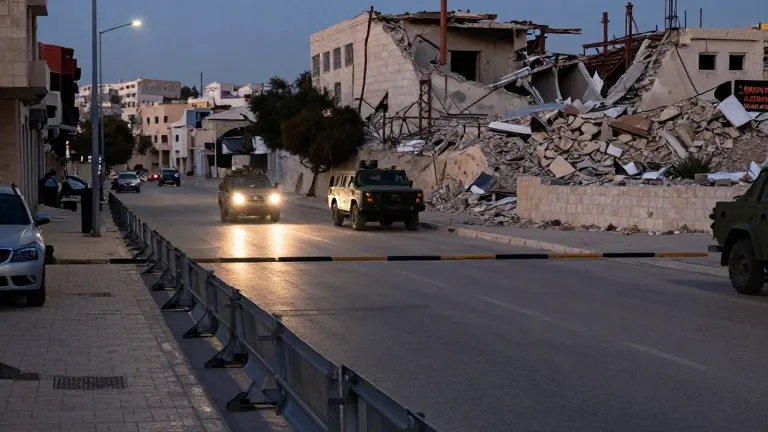
Within hours of the attack, the city of 250,000 residents was sealed off, and the Farsh al-Hawa neighborhood, closest to the site, was flattened, leaving only rubble from an industrial area that contained car workshops and a ceramics plant.
In the district of Ein Deir Baha, located a few kilometers away, the army displaced 370 families, comprising nearly 2,000 people, according to the Hebron municipality.
Fahed Ahmaro, an imam in the district, was woken at midnight by loudspeakers on military vehicles ordering residents to leave for their safety, and his family of 30 members moved to a relative’s home.
Abdul Halim al-Tamimi, 77, stated that the military gave his family 10 minutes to leave at 1:30 am, and an intelligence officer threatened to displace them as was done in Gaza if they refused, forcing the family out by 3 am.
By Sunday morning, the al-Tamimi villa was draped in large Israeli flags and used as an army headquarters, while the army described the displaced residents as members of the Jaba'a clan, a group it said was associated with Hamas and numbered about 2,000 people.
Residents of Ein Deir Baha rejected the army’s account, stating that the Jaba'a clan numbers at most 150 people and has no known reputation for radicalism, and the Hebron municipality said the army kept media out of the district.
By Sunday evening, all roads in and out of Hebron remained closed to cars behind heavy steel barriers, and only pedestrians moved through the city, while delivery driver Wasam Sadi reported that settlers had attacked him at a nearby junction, leaving him with a smashed windshield and glass in his eyes.