Heat and pests threaten New Jersey's family-run cranberry harvest
Growers in the Pine Barrens face rising costs and crop damage as warming weather disrupts the southern limit of U.S. cranberry production.
By Isaac Medina ·
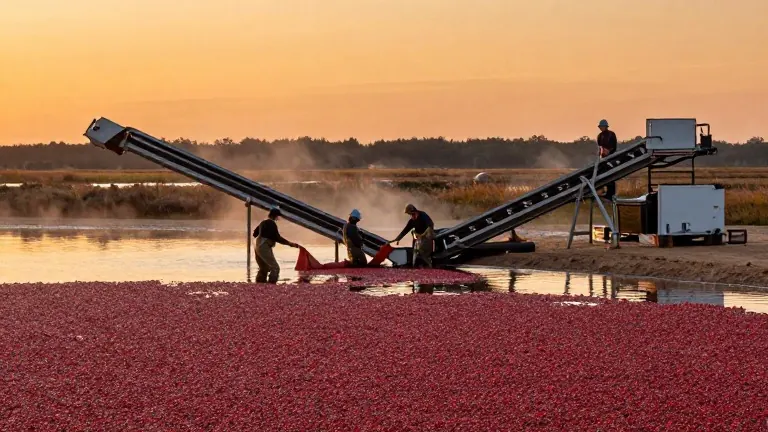
New Jersey sits at the southern edge of the country's cranberry growing region, a position that makes its farms the first line of defense against shifting climate patterns. From mid-September to November, the state's Pine Barrens fill with red fields as workers flood bogs to harvest the crop.
The industry is small but deeply rooted. According to the U.S. Department of Agriculture, New Jersey produces approximately $20 million in cranberries annually. Most of these operations are family-owned businesses that have operated for generations. Shawn Cutts, a fifth-generation grower at Cutts Brothers, has worked his family's land since 1997 and noted that New Jersey farmers often encounter new agricultural challenges before their peers in colder states like Wisconsin and Quebec.
Rising temperatures are creating immediate risks for the fruit. Cutts explained that extreme heat can physically damage the berries before they are picked. During late summer, workers use meat thermometers to check individual berries. If the temperature reaches 108 degrees Fahrenheit, crews activate sprinklers to cool the vines. Cutts said that on hot, dry days, the fruit can cook on the vine, ruining the harvest.
Heat also encourages the growth of fungal diseases. Fruit rot, which severely reduces yields in New Jersey, is less common in cooler regions. James Shope, a climatologist at Rutgers University, added that erratic spring temperatures pose an additional threat. He warned that chaotic swings in early spring can cause plants to bloom too early, leaving them vulnerable to late-season frosts that destroy the crop.
Insect populations are also responding to the warming climate. Cesar Rodriguez-Saona, an entomologist at the Rutgers Marucci Center for Blueberry and Cranberry Research, noted that warmer temperatures accelerate insect development. This shift forces growers to adjust the timing of pesticide applications to match the new life cycles of the pests. Rodriguez-Saona is collaborating with Shope to develop a temperature-based model to help farmers determine the optimal window for treatment.
Long-term adaptation requires new plant varieties that can withstand higher heat. Researchers and growers agree that breeding heat-resistant strains is necessary for the industry's survival. However, the process is slow and requires extensive planning. Cutts emphasized that multigenerational farms must think in long time horizons. He stated that some solutions will only benefit the next generation, but that long-term thinking is essential for the industry to remain viable.
The state's cranberry sector thus faces a dual pressure of immediate crop management issues and the slow, expensive work of genetic adaptation. As the southernmost major producer in the United States, New Jersey continues to serve as a testing ground for how a cold-climate crop survives in a warming world.
More Business · Bad Business · Report a business · Got a Story?