Immigrants detail journeys from poverty to prosperity
Speakers at an Annandale event described financial hurdles and professional achievements, ranging from $500 in savings to leading U.S. government consultancies.
By Anthony Shevchenko ·
Ricardo Noserale owned a home improvement business in the United States after growing up on a farm in the Philippines. He now serves as president of the Falls Church Rotary Club. Noserale shared this background during a National Immigrants Day event held on Oct. 31 in Annandale.
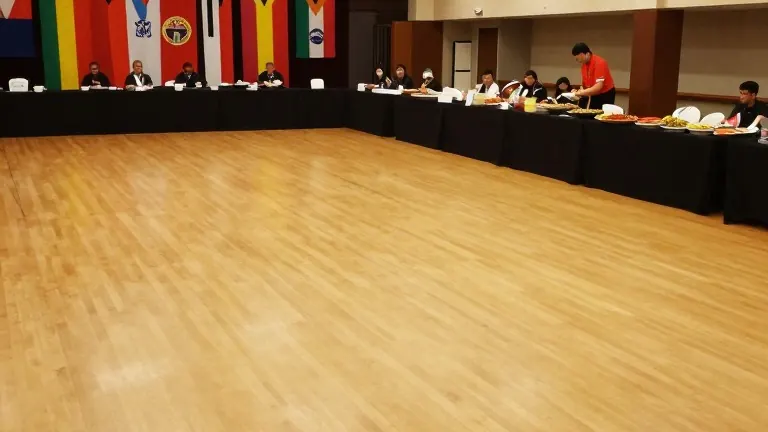
The Asian American Community Center organized the gathering at American Legion Post 1976. The event included Asian food, entertainment, and a display of international flags at the Eileen Garnett Civic Space. Attendees heard personal accounts from individuals who migrated to the U.S. from Indonesia, Korea, and the Philippines.
Kee Jun, president of the Coalition of Asian Pacific Americans of Virginia, detailed her parents' arrival from Korea in 1972. The family brought five children to the U.S. with only $500 in cash. Jun stated that her parents relied on hard work and sacrifice to build opportunities for their family.
Dwitra Zaky, an immigrant from Indonesia, works as a consultant for U.S. agencies. She advises on language and culture to strengthen ties with Southeast Asia. Zaky also founded a boutique that sells traditional Indonesian designs to Western markets.
Jim Holcomb, past president of the Annandale Rotary Club, noted that President Ronald Reagan established Oct. 28 as National Immigrants Day in 1987. The date marks the anniversary of the Statue of Liberty's unveiling. Holcomb said the holiday serves as a reminder for Americans to embrace hard-working immigrants.
Holcomb, a former history teacher and pharmaceutical executive, contrasted the immigrant experience at Ellis Island with Angel Island in San Francisco Bay. He explained that Angel Island enforced strict regulations under the Chinese Exclusion Act. Between 1910 and 1940, more than 300,000 Asian immigrants were detained there.
Megan Thy Nguyen, head of programming for George Washington University’s Vietnamese Student Association, asked the audience to visualize the process of starting a new life. She described crossing an ocean with nothing and learning English without subtitles. Connie Chi Park, leader of the Virginia chapter of Make Us Visible, shared the story of Florence Finch.
Finch, from the Philippines, risked her life during World War II to supply American prisoners of war with food and medicine. She was captured and tortured by Japanese forces. After the war, Finch enlisted in the U.S. Coast Guard and received the Medal of Freedom. Park stated that while many immigrants build businesses and raise families, their contributions often go unrecognized.