Voter turnout jumps as Trump reverses campaign plans
Early voting in battleground states has surged past 2022 levels, prompting the president to reschedule rallies in Iowa and Kansas while a federal probe targets a ballot confusion scheme in Alaska.
By Beatriz Soto ·
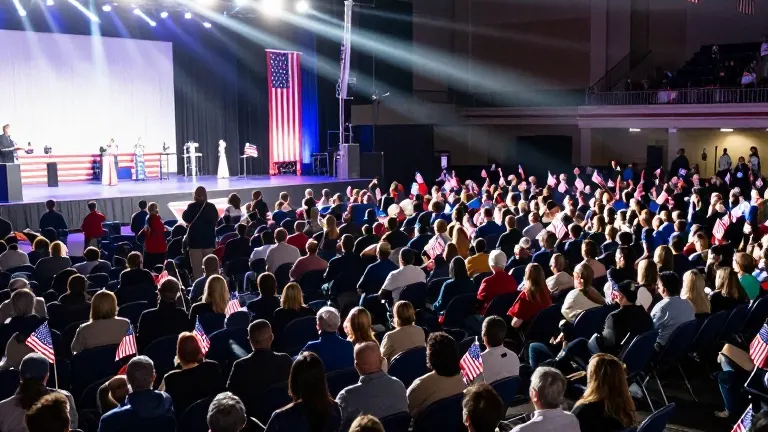
Nearly 10 million more Americans cast ballots in the five days preceding the 2026 midterm elections than at the same point in 2022, according to an Associated Press analysis of voting data. The spike in participation has intensified the race for control of the U.S. Senate, forcing President Donald Trump to alter his campaign strategy in two key states.
Trump canceled planned weekend visits to Iowa and Kansas less than 24 hours before he was scheduled to travel. He then rescheduled back-to-back rallies in those states for Sunday. The president stated he received calls from supporters in both states who preferred live events over tele-rallies. He noted that they told him he would be more effective in person.
Early voting figures are particularly high in states with competitive Senate races. In Iowa and Kansas, early voting has increased by roughly 30 percent compared to the same period in 2022. Both parties believe the surge in turnout favors their candidates as they fight on issues of affordability and presidential popularity.
Trump has headlined 25 rallies in October as part of a push to support Republican Senate candidates. He arrived in Daytona Beach, Florida, on Friday night ahead of his renewed travel plans. His campaign targets include Sen. Roger Marshall in Kansas and Rep. Ashley Hinson in Iowa, who is running for the Senate seat currently held by a Democrat.
In Alaska, U.S. Attorney Michael Heyman confirmed a federal investigation into a candidate named Dan J. Sullivan. The probe examines an alleged scheme to confuse voters by placing a candidate with the same name as the Republican incumbent, Sen. Dan Sullivan, on the ballot. Law enforcement assets were sent to the state this week after reports suggested the campaign of Democratic candidate Mary Peltola was involved in recruiting the second Sullivan.
Peltola denied on Thursday that she knew about the effort to add the additional candidate. The Justice Department stated it intends to isolate ballots ranking Dan J. Sullivan to measure the level of voter confusion. The investigation has been underway for several months.
In Michigan, tensions remain high among Democrats following a close primary in August. Rep. Haley Stevens, who lost to Abdul El-Sayed, appeared on CNN to say she would vote for El-Sayed. She called on him to repair relations with Jewish and Black voters. Stevens also criticized El-Sayed in a social media post on Friday, demanding he address an advertisement linking U.S. support for Israel to rising grocery prices.
Stevens wrote that El-Sayed promised to get money out of politics and that he could begin by getting Israel out of his explanations for Michigan's costs. El-Sayed responded in a statement that Stevens seemed intent on relitigating the primary. He urged his party to focus on defeating Republican candidate Mike Rogers.
Voter participation is rising in other competitive states as well. In Texas, more than 6.3 million voters cast early ballots as of Wednesday, a 50 percent increase from 2022. In South Carolina, early voting is up 83 percent as voters choose a successor to the late Sen. Lindsey Graham. Maine, Michigan, North Carolina, and Kansas have all seen advance voting increase by more than 30 percent.
Historic amounts of money have flowed into this year's elections. Republicans have expressed concern that voter dissatisfaction with Trump and high costs could suppress turnout among their base. Democrats have focused their campaigns on these affordability issues to capitalize on the current economic climate.