Russia and China Expand Arctic Freight Pact Amid EU Strategy
New agreements aim to increase traffic on the Northern Sea Route, a corridor that carried 3.7 million tonnes of cargo in nine months of 2026.
By Anthony Shevchenko ·
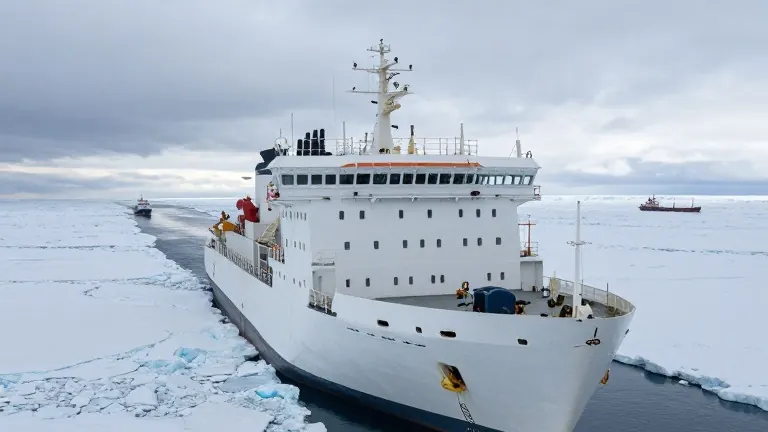
Moscow and Beijing agreed last week to increase freight traffic along Arctic shipping corridors and deepen cooperation on polar vessel construction. The pact includes expanding services between their respective ports. It was announced following the European Union's release of a new Arctic strategy designed to counter growing Russian and Chinese influence in the region.
The Northern Sea Route offers a shorter path for cargo moving between Asia and Europe. According to data from Fertmax FZCO, the journey takes between 18 and 22 days. This is approximately 35% faster than the 28 to 35 day trip through the Suez Canal. For Moscow, the route provides a way to redirect energy exports toward Asia as Western sanctions limit access to European markets. For Beijing, it offers an additional trade artery that reduces reliance on traditional maritime chokepoints.
David Roche, a strategist at Quantum Strategy & Geonomics, stated that the route's primary value lies in the deepening economic dependence between the two nations. "The significance of the arctic route is for Russian energy shipments to China, which will increase China's control over Russia in terms of Russia's dependence on China to sell its energy to compensate for losses of its gas markets in Europe," Roche said.
Europe faces structural disadvantages in challenging this partnership. Moscow controls the Northern Sea Route, including shipping permits, transit fees, and a fleet of nuclear icebreakers. Beijing supplies the cargo, vessels, and industrial capacity needed to develop the corridor. By contrast, Europe has limited icebreaker capacity and Arctic infrastructure. Kaja Kallas, the EU foreign policy chief, noted the region's strategic value in her remarks on the new strategy last week.
The EU strategy proposes expanding European icebreaker capacity and strengthening maritime surveillance. It also calls for a maritime security hub and greater protection for undersea cables. These measures address concerns about Russian military activity and threats to critical infrastructure. However, experts note that these steps may not overcome the structural advantages held by Moscow and Beijing.
Daeijin Lee, former global head of research at Fertmax FZCO, said Western operators face sanctions, insurance, and compliance complications that make the route less attractive than it is for Chinese companies. "The Arctic gives diversification, not independence," Lee said. Europe also faces a dilemma: engaging with the corridor could increase reliance on Russian-controlled infrastructure even as it seeks to reduce Moscow's economic influence.
Arctic trade currently accounts for roughly 0.3% of global shipping. Data from Rosatom and UN Trade and Development figures show 37.02 million tonnes of cargo transited the Northern Sea Route in 2025. Only 3.2 million tonnes of that cargo involved vessels transiting the entire route, according to the Centre for High North Logistics. Traffic has increased in 2026. The Centre for High North Logistics recorded 104 confirmed transit voyages carrying an estimated 3.7 million tonnes of cargo by the end of September 2026. This exceeds the 3.2 million tonnes recorded during the entire 2025 navigation season.
Most existing traffic consists of Russian oil, liquefied natural gas, and other commodities rather than international container shipments. Ice conditions restrict navigation for much of the year, and specialized vessels, insurance premiums, and Russian transit fees can erode savings from shorter voyages. Matthew Wright, an analyst at Kpler, said the route remains poorly suited to replacing established corridors because operators need reliable, year-round services. A study in the WMU Journal of Maritime Affairs projected that melting polar ice could increase the Northern Sea Route's annual transit capacity to between 127 million and 463 million tonnes by 2050.