Eisenkot Secures 67 Knesset Backers
President Isaac Herzog confirmed the Yashar leader has the support of a majority of lawmakers, setting the stage for a Sunday mandate decision.
By Isaac Medina ·
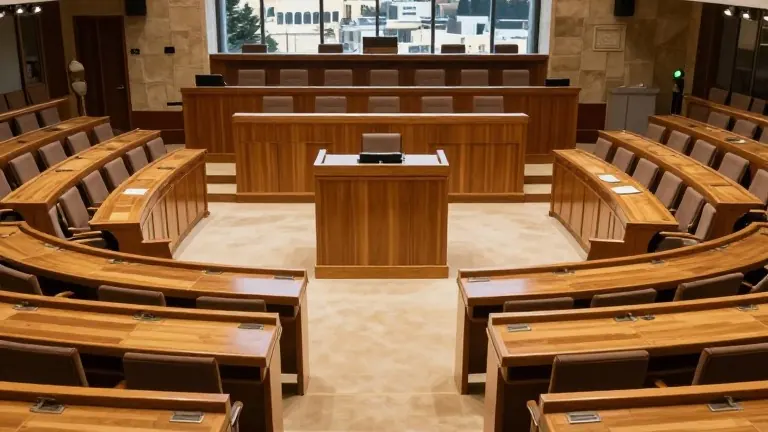
Gadi Eisenkot of the Yashar party secured the backing of 67 members of the Knesset on Thursday, according to President Isaac Herzog. The president conducted consultations with party factions and determined that Eisenkot holds a majority. In contrast, 46 lawmakers recommended Prime Minister Benjamin Netanyahu. Herzog described the outcome as clear but stated he would hold additional talks before formally assigning the mandate to form a government on Sunday.
Yashar leadership urged Herzog to hand the mandate to Eisenkot immediately. The party noted that 67 recommendations constitute the highest number for any candidate since 2015. However, the path to building a coalition remains complex. Netanyahu and his allies lost their majority in the election held last week. The parties opposing Netanyahu are divided into two distinct groups: a 48-member bloc led by Jewish parties and a 19-member bloc led by Arab parties.
Netanyahu currently leads a bloc of 46 members. This shift occurred after the United Torah Judaism party, which holds seven seats, refused to recommend its long-time ally. This refusal appears to open a path for UTJ to support Eisenkot in a future coalition. Channel 12 reported that Avigdor Liberman, head of Yisrael Beytenu, has lifted his long-standing refusal to sit with Haredi parties. Liberman is reportedly open to partnering with UTJ, viewing the removal of Netanyahu as the top priority. He prefers Haredi factions over Arab-led ones. Reports indicate such a government would involve a rotation between Liberman and Eisenkot, along with talks on a Haredi military draft agreement.
The incoming Knesset is scheduled to be sworn in on November 10. Members may also elect a new speaker, a position with considerable influence over the legislative agenda. Ra'am formally joined Yashar, the Joint List, Yisrael Beytenu, and the Democrats in calling for an early vote on the speaker. Current Speaker Amir Ohana stated he will schedule a debate on his replacement if at least 61 lawmakers formally request it.
Ra'am leader Mansour Abbas condemned terrorism during his consultation with Herzog. He called for Hamas to be disarmed and removed from power but stopped short of explicitly labeling the group a terrorist organization. Eisenkot had set that label as a condition for potential partners. Abbas recalled the 2021 coalition he formed with Yair Lapid and Naftali Bennett, stating that its worst day was infinitely better than the fully right-wing government. When pressed on joining a government that fights terrorism without limits, Abbas said: "To claim that our presence in a government would prevent a cabinet or government from defending Israeli citizens is not right."
Abbas questioned why his party faces repeated loyalty tests. He noted that no Ra'am lawmaker has been charged with terrorism offenses, while Itamar Ben Gvir, leader of Otzma Yehudit, was convicted in 2007 of incitement to racism and support for a Jewish terrorist organization. Yoav Segalovitz, Ra'am's first Jewish candidate, called the discourse toxic and identified Netanyahu as the leader of it. Segalovitz said the real terror supporter is Ben Gvir, who sits in his government and was convicted.
Yousef Jabareen, chair of the Joint List, said recommending Eisenkot reflects Arab voters' demand for change. He cited racism, discrimination, crime, and exclusion as drivers. Jabareen acknowledged disagreements with Eisenkot on many issues but stated: "We are not choosing between good and better, but between what we see as bad and even worse." Ahmad Tibi, an MK for the Joint List, said the party would support a minority government from outside. He was unwilling to give it a safety net only to bring it down months later. Tibi stressed that with 11 seats, no parliamentary move can happen without the Joint List.
Merav Cohen, an MK for B'Yachad, called Eisenkot an extraordinary person who can form a government. She dismissed the idea of a unity rotation with Likud, recalling a past unity government whose agreements were broken one after another. Cohen said: "I learned not to do business with scorpions." Yoram Cohen of Yashar, a former Shin Bet chief, said it would be wrong to ignore the people's desire for change and go to another round of elections.
Likud ministers Yoav Kisch and Miri Regev urged the formation of a broad national government. Regev branded Eisenkot's bloc a disaster bloc. Herzog responded to the criticism by saying: "If you want to extend a hand, you can't call it a 'disaster bloc.'"